



Technical Analysis of U15, U16, and U17 Ultra-High Efficiency Filters
In the field of air purification, U15, U16, and U17 ultra-High Efficiency Filters form a rigorous filtration hierarchy. Their core differences lie in filtration precision, structural design, and targeted application scenarios. All three classes are validated using the MPPS (Most Penetrating Particle Size) testing method, but their performance parameters exhibit tiered improvements.
- Filtration Efficiency Comparison
U15 Class
Filtration efficiency: 99.9995% (MPPS)
Captures particles ≥0.12μm, suitable for ISO Class 5 (Federal Standard 100) cleanrooms.
Effective for 0.1μm particles, meeting requirements for biological laboratories and high-end electronics assembly lines.
U16 Class
Filtration efficiency: 99.99995% (MPPS)
Complies with ISO Class 4 (Federal Standard 10) standards.
Specialized Filter Media structure controls 0.06–0.1μm ultrafine particles, ideal for vaccine production facilities and semiconductor lithography zones.
U17 Class
Filtration efficiency: 99.999995% (MPPS)
Matches ISO Class 3 (Federal Standard 1) requirements.
Utilizes nanoscale fiber layering technology to capture 0.03μm particles, designed for nuclear research labs and aerospace component manufacturing.
- Structural Differences
- Filter Media
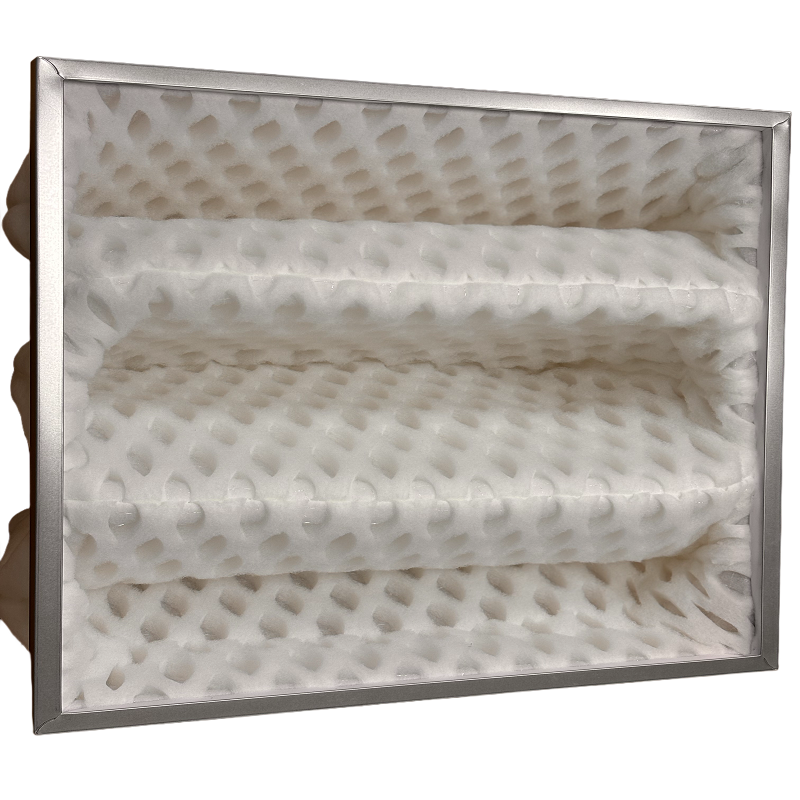
U15: Double-sided laminated glass fiber paper
U16: Composite nanocoated filter media
U17: Electrospinning-glass fiber hybrid structure with gradient filtration
- Sealing Technology
All classes use polyurethane integral casting seals.
U16/U17 add laser-welded metal frames to ensure zero leakage under 10Pa negative pressure.
- Frame Design
U15: Anodized aluminum alloy frame (25mm thickness)
U16: Stainless steel reinforced frame (30mm thickness)
U17: Titanium alloy honeycomb frame (35mm thickness)
- Application Scenarios
Class Typical Applications Air Changes/Hour Maintenance Cycle U15 Operating rooms, pharmaceutical filling lines 50–100 3–5 years U16 Semiconductor cleanrooms, genetic labs 100–300 2–3 years U17 Nanomaterial R&D centers, particle physics labs 300–600 1–2 years
- Cost-Benefit Analysis
Initial Investment: U17 costs 3.2× more per unit area than U15
Operational Energy:
U16 airflow resistance: 18% higher than U15
U17 airflow resistance: 35% higher than U15
Lifecycle Cost: U15 offers optimal cost-effectiveness for general applications .
5. Selection Guidelines
- Choose the minimum class meeting cleanliness requirements
- Analyze particle size distribution in industrial processes
- Evaluate HVAC system pressure margins and energy constraints
- Balance maintenance costs with downtime risks
Conclusion
U15 remains the mainstream choice due to its balanced performance, while U16/U17 serve specialized needs. Modern cleanroom engineering often adopts a U15+U17 hybrid system: U15 for pre-filtration to reduce load, and U17 for terminal purification. This strategy extends high-end filter lifespan by 40%+.
Data references: ASHRAE 52.2-2017 and ISO 29463 standards. Parameters reflect industrial best practices for technical decision-making.