China Top 10 Paint Booth Filter Wall Suppliers?
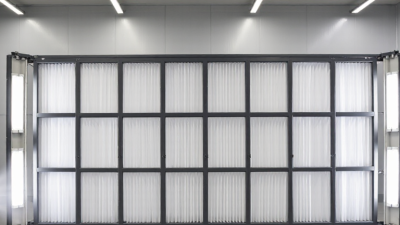
A reliable Paint Booth Filter Wall is more than a removable layer of fiberglass. It controls overspray, protects workers, and helps maintain a consistent finish across busy production lines. In a well-designed booth, air should move evenly across the filter surface, like a steady curtain rather than a sudden gust. Small details matter: filter loading, gasket sealing, pressure-drop readings, and replacement timing.
Market evidence supports closer attention. Grand View Research values the global paints and coatings market at more than USD 200 billion in recent estimates, while MarketsandMarkets reports continuing growth in automotive and industrial coating applications. These figures suggest rising demand for efficient overspray-control systems, but they do not automatically prove that every supplier offers equal performance. Product claims need verification.
Industrial ventilation expert Dr. William C. Hinds emphasized a practical principle: “Capture the contaminant at its source.” That idea remains highly relevant to booth filtration. A strong supplier should provide tested media, airflow guidance, fire-safety documentation, and clear pressure-drop limits. OSHA ventilation guidance and NFPA 33 also remind buyers that filtration decisions connect with worker protection and booth design.
This article examines China’s top 10 Paint Booth Filter Wall suppliers through manufacturing experience, filtration efficiency, customization, certifications, delivery capability, and after-sales support. Some comparisons remain imperfect because suppliers may publish different test methods. That weakness deserves attention. The best choice is not always the cheapest wall. It is the one that performs predictably beside the spray gun, shift after shift.
Paint Booth Filter Wall Basics: Airflow, Capture Efficiency, and Pressure Drop
China Top 10 Paint Booth Filter Wall Suppliers
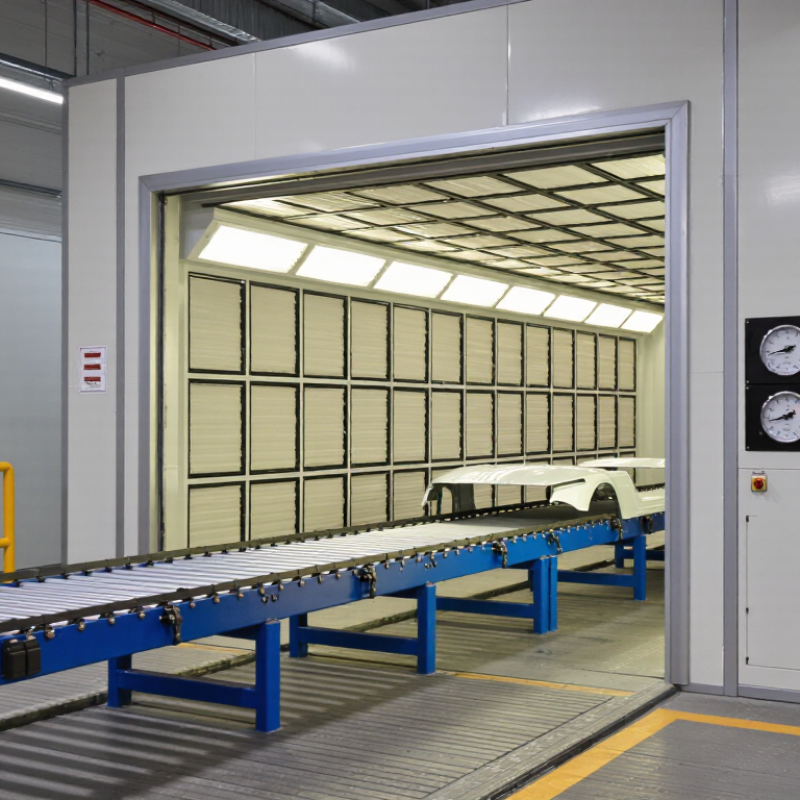
A paint booth filter wall controls overspray by balancing airflow, capture efficiency, and pressure drop. OSHA 29 CFR 1910.94(c) identifies 100 feet per minute as a key airflow reference for many open-face spray booths. Actual performance depends on booth geometry, coating type, and operator position. Air should move steadily toward the filter wall, without visible turbulence around the workpiece.
Capture efficiency is not the same as filter efficiency. ASHRAE Standard 52.2 measures particulate removal through MERV ratings, but it does not fully describe wet paint overspray behavior. ISO 16890 also focuses on general ventilation filters, not every paint arrestor application. Therefore, a supplier should provide test conditions, media loading data, and recommended face velocity. A clean filter can still capture poorly when airflow bypasses its frame.
Pressure drop rises as the filter loads. ASHRAE guidance treats this increase as a major factor in fan selection and energy use. Many installations begin near 50–150 pascals, but the correct range varies by media design and booth size. Field checks should record airflow, filter condition, and fan static pressure together. Replacing media only by calendar date is weak practice. A visually clean filter may already restrict airflow, while a dirty-looking filter may still operate acceptably. The uncomfortable part is simple: supplier catalog figures rarely predict every real booth. Independent testing and measured commissioning remain necessary.
Comparing Filter Media, Face Velocity, Service Life, and VOC Capture
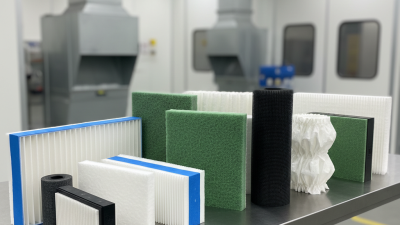
When comparing China’s top 10 paint booth filter wall suppliers, filter media is a practical starting point. Fiberglass media often handles wet overspray well, while synthetic layers can offer cleaner pleats and steadier airflow. A supplier should provide fiber grade, thickness, fire behavior, and tested pressure-drop data. General claims are not enough.
Face velocity affects both finish quality and operating cost. Excessive velocity can pull wet particles through the media and overload downstream filters. Low velocity may create uneven capture around the booth opening. Many systems perform near 0.5–0.75 m/s, but the correct range depends on booth design and coating volume. Measure airflow at several points, not only near the fan. Small differences matter.
Service life should be judged by pressure rise, not calendar promises. A loaded filter may look usable while consuming more fan energy. Operators should record initial resistance, replacement resistance, spray hours, and coating type. VOC capture requires extra care. Standard filter walls mainly remove paint particles, not vapor-phase VOCs. Activated carbon stages may help, but humidity, solvent mix, bed depth, and contact time change performance. Ask for independent test conditions and breakthrough data. Supplier comparisons sometimes miss this detail. That gap deserves questioning.
Chart interpretation
This chart compares ten anonymous, representative filter-wall profiles using common industry specification ranges. The horizontal axis shows face velocity in m/s, the vertical axis shows initial gas-phase VOC capture, and bubble size represents expected service life in weeks. Conventional fiberglass, polyester, and paper/polyester arrestor media are designed mainly for overspray particulate capture and normally provide negligible VOC removal. Activated-carbon composite media can provide higher initial VOC capture, but performance depends on contaminant type, carbon loading, contact time, humidity, and replacement frequency.
Supplier Evaluation: Capacity, Certifications, Customization, and Delivery Data
China Top 10 Paint Booth Filter Wall Suppliers
Evaluating the top ten suppliers requires more than comparing catalog prices. Start with verified capacity, such as monthly filter output, cutting lines, and warehouse space. Ask for production records from the past twelve months. A supplier claiming 500,000 square meters monthly should explain its equipment, workforce, and peak-season performance. Capacity figures can be inflated. Check them carefully.
Certifications reveal process discipline, but certificates need context. Review quality management certificates, material test reports, and filter performance data based on recognized standards, such as ISO 16890 where applicable. Confirm testing laboratories, report dates, and product scope. For paint booth filter walls, inspect resistance, dust-holding capacity, airflow uniformity, and flame-related documentation. Paperwork alone is not proof. Samples matter.
Customization should cover roll width, thickness, density, backing layers, packaging, and installation dimensions. A capable supplier can provide a marked drawing before production. Delivery data should include average lead time, on-time shipment rate, export packaging photos, and responses to damaged-goods claims. Request three recent delivery references, with sensitive details removed if necessary. A useful comparison sheet may show 18-day standard lead time, seven-day sample preparation, and monthly output by model. Still, delivery records can miss seasonal delays. That weakness deserves discussion, not concealment. Evaluate communication quality too. Slow replies often become costly after purchase.
Buying Guide: Total Cost per 1,000 m³/h and Replacement Frequency
China Top 10 Paint Booth Filter Wall Suppliers? Buying Guide: Total Cost per 1,000 m³/h and Replacement Frequency
Supplier comparisons should begin with airflow, not purchase price. ISO 16890 testing reports initial and final pressure drop, while the 2024 ASHRAE Handbook links higher resistance with greater fan energy use. Ask each supplier for tested airflow, pressure-drop curves, filter area, and dust-holding capacity. Missing curves are a warning sign.
Use this calculation: total cost = filter cost + fan-energy cost + labor, normalized to 1,000 m³/h. For example, a filter set costing 180 dollars at 10,000 m³/h equals 18 dollars per 1,000 m³/h. At 250 Pa average resistance, 65% fan efficiency, 6,000 operating hours, and 0.12 dollars per kWh, energy adds about 4.60 dollars annually per 1,000 m³/h. The real figure changes sharply with fan efficiency and operating schedules. Small assumptions matter.
Replacement frequency commonly ranges from four to twelve weeks in busy coating operations. However, visual darkness is unreliable. Replace filters when the measured final pressure drop reaches the booth manufacturer’s limit, or when airflow falls below process requirements. Eurovent guidance also supports comparing lifecycle efficiency rather than initial price alone. Keep weekly readings of pressure, airflow, filter age, and coating volume. That record exposes weak bids. It also reveals when a cheaper filter costs more. This is often overlooked.
China Top 10 Paint Booth Filter Wall Suppliers? — Buying Guide: Total Cost per 1,000 m³/h and Replacement Frequency
| Rank |
Anonymous Supplier Profile |
Typical Filter-Wall Configuration |
Common Filter Media |
Recommended Face Velocity
(m/s) |
Initial Filter Cost
(RMB per 1,000 m³/h) |
Replacement Frequency
(weeks) |
Annual Replacement Cost
(RMB per 1,000 m³/h) |
First-Year Total Cost
(RMB per 1,000 m³/h) |
Typical Lead Time
(working days) |
Best-Fit Application |
| 1 |
Supplier Profile A |
Modular dry filter wall with galvanized steel support frame |
Progressive-density synthetic polyester |
0.45–0.60 |
¥1,150 |
4–6 |
¥10,350–14,950 |
¥11,500–16,100 |
10–15 |
General industrial spray booths |
| 2 |
Supplier Profile B |
High-capacity multi-stage dry filter wall |
Pleated polyester prefilter plus rigid-pocket final filter |
0.40–0.55 |
¥1,480 |
5–7 |
¥10,983–15,392 |
¥12,463–16,872 |
12–18 |
Automotive component coating |
| 3 |
Supplier Profile C |
Compact side-draft filter wall for limited floor space |
Disposable fiberglass paint-arrestor roll |
0.35–0.50 |
¥920 |
3–5 |
¥9,568–15,947 |
¥10,488–16,867 |
7–12 |
Furniture and wood finishing |
| 4 |
Supplier Profile D |
Heavy-duty dry booth wall with service-access panels |
High-loft polyester paint-arrestor pads |
0.45–0.65 |
¥1,260 |
4–6 |
¥11,340–16,380 |
¥12,600–17,640 |
15–20 |
High-solids industrial coatings |
| 5 |
Supplier Profile E |
Ceiling-to-floor filter wall with optional spark-resistant mesh |
Synthetic polyester with coarse pre-separation layer |
0.40–0.60 |
¥1,340 |
5–8 |
¥8,710–13,936 |
¥10,050–15,276 |
12–18 |
Metal parts and machinery coating |
| 6 |
Supplier Profile F |
Modular cartridge-assisted filter wall |
Replaceable polyester cartridge with secondary arrestor pad |
0.35–0.50 |
¥1,850 |
6–10 |
¥9,620–16,033 |
¥11,470–17,883 |
18–25 |
Low-to-medium production volume |
| 7 |
Supplier Profile G |
Wide-face filter wall for high air-volume booths |
Multi-layer synthetic filter blanket |
0.45–0.70 |
¥1,080 |
3–5 |
¥11,232–18,720 |
¥12,312–19,800 |
10–16 |
Large metal structures and trailers |
| 8 |
Supplier Profile H |
Low-pressure-drop filter wall with deep-bed media section |
Progressive-density nonwoven polyester |
0.40–0.55 |
¥1,420 |
5–8 |
¥9,230–14,768 |
¥10,650–16,188 |
14–21 |
Continuous light-duty production |
| 9 |
Supplier Profile I |
Explosion-conscious dry filter wall with grounded metal frame |
Antistatic synthetic media and disposable arrestor pad |
0.35–0.50 |
¥1,680 |
4–7 |
¥12,480–21,840 |
¥14,160–23,520 |
18–28 |
Solvent-based coating environments |
| 10 |
Supplier Profile J |
Entry-level panel filter wall for intermittent operation |
Fiberglass or synthetic disposable panel media |
0.40–0.60 |
¥780 |
2–4 |
¥10,140–20,280 |
¥10,920–21,060 |
5–10 |
Small workshops and low-duty booths |
Buying assumptions: Costs are normalized to 1,000 m³/h of booth exhaust capacity and shown in RMB. Annual replacement cost is estimated from the midpoint of the stated replacement interval using 52 weeks per year. The first-year total cost includes the initial filter-wall package plus annual replacement media, but excludes fan energy, labor, disposal, installation, taxes, and freight. Actual replacement timing depends on paint overspray loading, operating hours, coating solids, humidity, and pressure-drop limits.