Leave Your Message
Choosing the right Spray Booth Inlet Filters can determine whether a painted surface looks clean or shows tiny dust marks. In a busy booth, even one poorly fitted filter can disturb airflow, increase overspray movement, and waste finishing time. The choice deserves more than a quick price comparison.
Dr. Peter Tsai, an air-filtration researcher and inventor, explains, “Filtration works best when the filter, airflow, and maintenance plan are designed together.” This principle fits spray booth operations closely. A filter must match the booth’s airflow, frame dimensions, pressure limits, and working environment. High efficiency alone is not enough. A dense filter may capture more particles, but it can also restrict airflow sooner than expected.
Small details matter.
Before choosing, inspect the filter face, gasket, support grid, and pressure-drop readings. Look for visible dust trails around the frame. They may reveal bypass air, not poor filter media. Check whether the filter remains stable during shift changes and seasonal humidity. A practical trial can help: install the candidate filter, record initial pressure, and compare its condition after several operating days.
Perfection is unlikely.
The best selection process still has weaknesses. Manufacturer ratings may use different test methods, while real booths experience changing loads. That is why this guide examines seven practical considerations, including efficiency, airflow capacity, dust-holding performance, fit, maintenance, material quality, and total operating cost. These points help managers make a safer, cleaner, and more defensible decision for their specific booth.
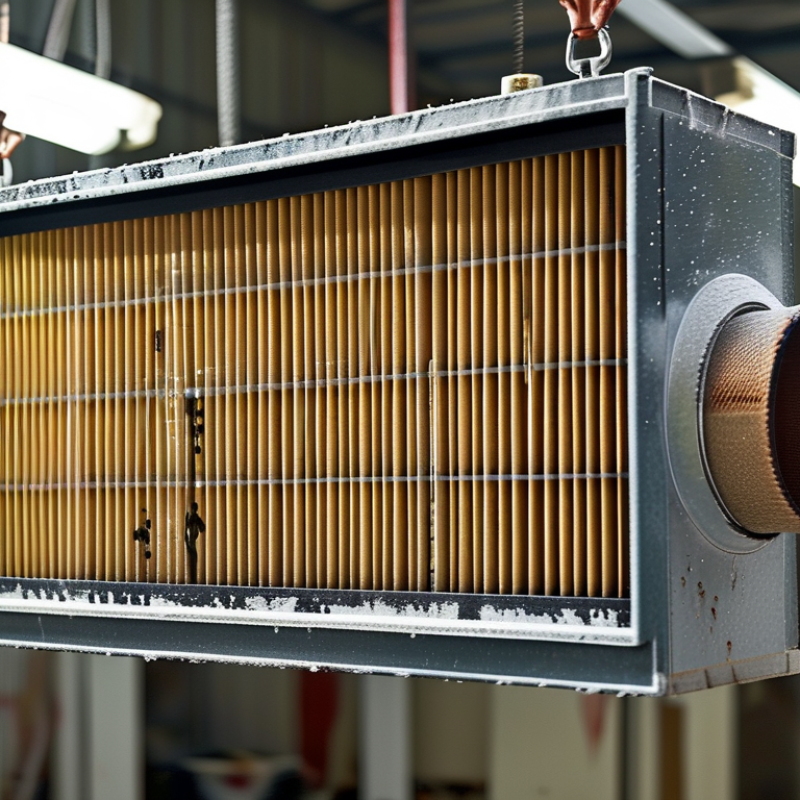
Choosing a spray booth inlet filter starts with airflow, not a filter label. A clogged panel increases pressure drop, weakens booth balance, and can leave dust on a wet finish. ASHRAE Standard 52.2-2017 evaluates particle removal by size, while ISO 16890 groups filters as ePM1, ePM2.5, or ePM10. These systems are not directly interchangeable. MERV 13, for example, requires at least 85% efficiency for 1–3 micron particles under ASHRAE testing. ISO ePM1 uses a different test method and reporting basis.
Tip: Measure airflow at the booth face and record the filter’s initial pressure drop. A filter with excellent efficiency may still be unsuitable if the fan cannot maintain design volume. Field audits often find neglected filters operating far beyond their intended loading range. That is not a small maintenance issue; it changes capture performance and finish consistency.
Use the booth manufacturer’s airflow requirement as the fixed point. Then compare MERV or ISO data, dust-holding capacity, and replacement intervals. The U.S. Environmental Protection Agency’s particulate-matter guidance identifies fine particles below 2.5 microns as a significant indoor-air concern, but booth selection also depends on coating overspray and process hazards. A higher rating is not automatically safer or better. I would also inspect the gasket, frame, and sealing surface. Even a high-grade filter performs poorly when air bypasses its edges.
Tip: Check pressure drop weekly during heavy production. Record readings. Trends reveal loading earlier than appearance does. ISO 16890 itself warns that laboratory results cannot predict every installed condition, so real-world verification remains necessary.
| No. | Selection Dimension | Practical Guidance | Relevant Data or Rating | Why It Matters |
|---|---|---|---|---|
| 1 | Match the filter to the airflow design | Select a filter that can handle the booth's calculated air volume without excessive resistance. Confirm the filter's rated airflow and pressure-drop curve before purchase. | Airflow is commonly expressed in m³/h or CFM. Face velocity should be checked against the booth design; many spray-booth applications use approximately 80–120 ft/min (0.41–0.61 m/s), but the design specification takes priority. | An undersized filter can increase pressure drop, reduce airflow, and disturb spray capture and finish quality. |
| 2 | Choose the appropriate filtration stage | Use a coarse prefilter to capture larger dust and fibers, followed by a finer inlet filter when cleaner booth air is required. Keep the filter sequence compatible with the air-handling unit. | Typical prefilter choices include ISO Coarse or lower-to-mid MERV ratings. Finer final-inlet filters may be selected in the MERV 11–13 range or an appropriate ISO ePM class, subject to the system design. | Staged filtration extends final-filter life and helps prevent rapid loading by large particles. |
| 3 | Interpret MERV ratings correctly | Use MERV as a laboratory performance classification under ASHRAE 52.2. Do not select a filter from the MERV number alone; also review airflow capacity, initial resistance, and dust-holding behavior. | MERV 8 is generally used for basic particulate control; MERV 11 provides higher fine-particle performance; MERV 13 offers stronger capture of particles in the smaller test-size ranges. Exact performance must be verified from the test report. | A higher rating can improve particle removal but may also create higher initial pressure drop if the filter area is not increased. |
| 4 | Use ISO 16890 classes for global comparison | When the supplier provides ISO 16890 data, compare the reported ePM1, ePM2.5, ePM10, or ISO Coarse value with the required particle-control objective. | ISO 16890 reports efficiency against particulate-size fractions: ePM1 for particles up to about 1 µm, ePM2.5 for particles up to about 2.5 µm, ePM10 for particles up to about 10 µm, and ISO Coarse for filters that do not meet the required fine-particle threshold. | ISO 16890 and MERV use different test methods and should not be treated as exact one-to-one conversions. |
| 5 | Check pressure drop and service limit | Compare initial resistance at the intended airflow with the fan's available static pressure. Install a differential-pressure gauge or monitoring switch where practical. | Pressure drop is normally reported in Pa or in. w.g. Replace or clean the filter when the measured final resistance reaches the equipment manufacturer's limit, rather than relying only on a calendar schedule. | Monitoring resistance helps maintain consistent airflow and avoids unnecessary filter replacement. |
| 6 | Select the correct media and construction | Choose media, frame, gasket, and support components that are compatible with the booth's temperature, humidity, dust loading, cleaning method, and airflow direction. | Common inlet-filter media include synthetic or glass-fiber materials. Available formats may include panel, pleated, bag, or rigid-cell filters. Verify dimensions, airflow direction, seal type, and flame or fire-performance requirements. | Correct construction reduces bypass leakage, deformation, premature failure, and installation errors. |
| 7 | Balance cleanliness, cost, and maintenance | Evaluate total operating cost, including purchase price, replacement frequency, labor, disposal, energy use, and the effect of pressure drop on fan power. | A larger filter face area generally lowers face velocity and pressure drop at the same airflow. Use the filter's rated dust-holding capacity and measured pressure-drop data for lifecycle comparisons. | The lowest purchase price may not provide the lowest total cost or the most stable booth performance. |
| Important: MERV and ISO 16890 classifications describe particulate-filter performance under their respective test methods. They do not replace the spray-booth manufacturer's airflow, fire-safety, ventilation, or occupational-safety requirements. Always verify the selected filter against the equipment design and applicable local regulations. | ||||