Leave Your Message

China Top Ceiling Filter Manufacturers for Global Buyers?

Choosing among China’s top Ceiling Filter manufacturers requires more than comparing catalog prices. Global buyers must examine filtration performance, factory capability, material quality, and after-sales support. A reliable supplier should explain its filter media, frame design, gasket options, and production controls clearly.

Ceiling filters serve different environments, including hospitals, pharmaceutical rooms, food facilities, and industrial cleanrooms. Buyers should confirm dimensions, airflow resistance, particle-retention data, and replacement frequency before ordering. ISO 16890 classifications may support general HVAC selection, while specialized cleanrooms may require other recognized testing methods. The correct standard depends on the application.

Factory experience matters. A capable manufacturer can provide samples, test reports, batch records, and clear packaging details. Buyers should also inspect how filters are sealed, stored, and protected during ocean transport. A crushed corner can weaken an otherwise suitable product. Small details matter.

However, the market is not perfectly uniform. Some online claims appear stronger than the available evidence. That gap deserves attention. A supplier may show modern equipment but provide limited data on long-term consistency. Independent verification remains valuable. Requesting a sample, checking production capacity, and reviewing customer references can reduce avoidable risk. Pricing is important, but it should not replace technical judgment.

This guide introduces practical ways to evaluate leading Chinese Ceiling Filter manufacturers for international procurement. It focuses on evidence, application fit, communication, and dependable delivery. No single supplier suits every project. Careful comparison usually produces the safer decision.

China Top Ceiling Filter Manufacturers for Global Buyers?

What Are Ceiling Filters and Why Are They Important?

Ceiling filters are porous air-cleaning media installed above work areas, spray booths, or controlled production rooms. They capture dust, fibers, and other airborne particles before air reaches sensitive surfaces. Some models also help distribute airflow evenly across the ceiling. Not merely a fabric sheet.

Their importance becomes clear in daily operation. A loaded filter can reduce airflow, increase fan energy, and create uneven pressure. Poor filtration may leave dust on painted panels, medical equipment, or precision components. A filter that looks clean can still perform poorly.

Particle efficiency, pressure drop, dust-holding capacity, and moisture resistance must be checked together. In my view, buyers often focus too heavily on efficiency figures. That assumption needs reconsideration.

When evaluating Chinese ceiling filter manufacturers, global buyers should request technical data, test methods, material specifications, and production traceability.

Samples should be tested under working conditions, not only accepted by appearance. Check dimensions, sealing edges, airflow resistance, flame behavior, and lot consistency. Independent laboratory reports can strengthen reliability, while clear inspection records support long-term purchasing decisions.

Suppliers with practical experience should explain how the filter performs after loading, not merely provide an attractive initial value. Local safety and environmental requirements still apply, even when products are exported.

Some details may be overlooked during fast sourcing. That is why a small trial order, documented feedback, and repeat testing can reveal weaknesses before full-scale installation.

How to Evaluate Chinese Ceiling Filter Manufacturers

China Top Ceiling Filter Manufacturers for Global Buyers?

Evaluating Chinese ceiling filter manufacturers requires more than comparing prices. Visit the production site, or request a live video inspection. Check whether the factory controls fiber selection, adhesive application, cutting, and packaging. Ask for recent test reports, not only sample documents. Reliable data should identify airflow, pressure drop, filtration efficiency, and testing conditions. Batch numbers should connect the report to shipped products. This detail often separates a real manufacturer from a trading office.

Tips: Request three production samples from different batches. Inspect fiber density, edge sealing, dimensions, and surface damage. Ask how rejected products are recorded. Confirm the factory’s quality system, equipment maintenance records, export experience, and response time for complaints. A clear technical contact matters.

Do not trust polished catalogs alone. During evaluation, compare the sample with the specification sheet under normal lighting. Uneven density may affect airflow. Weak packaging can also damage filter media before installation. I would avoid accepting one laboratory report as permanent proof; materials and processes can change. Require pre-shipment inspection for early orders, then review performance after installation. A dependable supplier should explain limitations honestly, provide replacement procedures, and adapt dimensions without hiding tolerance issues. Price is useful, but traceability and consistent performance deserve greater weight.

China Top Ceiling Filter Manufacturers for Global Buyers? - How to Evaluate Chinese Ceiling Filter Manufacturers
Evaluation Dimension Relevant Benchmark or Technical Expectation Evidence Global Buyers Should Request Importance Buyer Verification Action
Filter Classification For high-efficiency applications, EN 1822 classifies filters such as E10–E12 and H13–H14. A compliant H13 filter has a minimum integral efficiency of 99.95% at the most penetrating particle size, while H14 has a minimum integral efficiency of 99.995%. Current product datasheet, classification report, test method, tested filter dimensions, airflow, pressure drop, and the laboratory identification. High Confirm that the claimed grade is based on the same standard and operating conditions required for the project.
Air-Filter Testing Standard General ventilation filters are commonly evaluated under ISO 16890, which reports performance using particulate-matter categories such as ISO Coarse, ePM10, ePM2.5, and ePM1. HEPA filters are commonly evaluated under EN 1822 or an equivalent recognized method. Full test report rather than a marketing certificate; report number, standard edition, sample description, test date, and measured results. High Check whether the report covers the exact filter media, frame, gasket, separator, and finished product supplied.
Airflow and Pressure Drop Pressure drop depends on media area, face velocity, filter depth, pleat geometry, and loading. A credible performance curve should show pressure drop across the specified airflow range instead of presenting only one value. Airflow-versus-pressure-drop curve, rated airflow, initial resistance, recommended final resistance, and test configuration. High Compare the reported data with the ceiling terminal unit or HVAC fan allowance to avoid insufficient airflow or excessive energy use.
Ceiling Module Compatibility Common ceiling terminal filter formats include compact panels and gel-seal or gasket-seal modules. The filter must match the terminal housing, clamping mechanism, airflow direction, and access arrangement. Dimensional drawing, tolerances, sealing detail, mounting instructions, allowable installation orientation, and sample inspection record. High Measure the existing housing and approve a production sample before placing a volume order.
Leakage and Sealing For high-efficiency ceiling filters, bypass leakage around the frame or gasket can reduce system performance even when the filter media meets its efficiency rating. Seal-material specification, gasket hardness or gel specification, frame-joint construction, leak-test procedure, and installation-sealing instructions. High Inspect corner joints and gasket continuity; require an installation leak test where the application is contamination-sensitive.
Filter Media and Construction Important construction variables include glass-fiber or synthetic media, separator or mini-pleat design, galvanized or aluminum frame, adhesive, protective screen, and gasket material. These variables affect efficiency, resistance, strength, and chemical compatibility. Bill of materials, media technical sheet, adhesive and gasket specifications, material certificates, and change-control procedure. High Ensure that the materials listed in the test report match the materials approved for mass production.
Mechanical Strength Ceiling filters must withstand handling, installation clamping, vibration, and the pressure differential expected in service without frame deformation or media damage. Frame-strength data, filter integrity inspection records, packaging-drop evaluation, and photographs of construction details. Medium Perform visual and dimensional checks on pre-shipment samples, including frame squareness and pleat stability.
Cleanroom and HVAC Suitability Applications such as hospitals, pharmaceutical areas, laboratories, electronics production, and food processing may require different cleanliness, temperature, humidity, chemical-resistance, and installation controls. Application references without confidential customer information, installation method statement, environmental limitations, and compatibility data for cleaning agents. High Match the filter design to the room classification, air-change target, terminal unit, and local regulatory requirements.
Factory Quality Management A structured quality system should control incoming materials, production parameters, in-process inspection, final inspection, nonconforming products, corrective actions, and traceability. Quality-management certificate, process flow chart, inspection plan, calibration records, internal audit evidence, and corrective-action samples. High Verify the certificate scope and site address; conduct a remote or on-site process audit for strategic orders.
Batch Traceability Each shipment should be traceable to production date, raw-material batch, operator or line, test result, and packaging record. Sample label, batch numbering rules, inspection report, certificate of conformity, and retention-period policy for quality records. High Ask the manufacturer to demonstrate backward and forward traceability using a randomly selected batch number.
Independent Laboratory Verification Independent testing is more reliable when the laboratory is technically competent, the report identifies the exact sample, and the test conditions reflect the intended application. Complete laboratory report, laboratory accreditation details where applicable, sample photographs, test date, and chain-of-custody information. High Contact the laboratory through independently verified contact details and confirm the report number and sample description.
Production Capacity Capacity should be evaluated by the actual production process, equipment, shifts, material availability, inspection resources, and reserved capacity rather than by a headline annual figure alone. Production-line photographs or audit records, monthly capacity statement, lead-time history, equipment list, and current utilization range. Medium Compare the requested monthly volume with demonstrated output and require a written peak-season delivery plan.
Lead Time and Supply Continuity Reliable supply depends on media availability, frame and gasket sourcing, production scheduling, export documentation, and contingency planning. Typical production lead time, raw-material sourcing plan, safety-stock policy, business-continuity procedure, and shipment performance history. High Include delivery milestones, delay notification rules, and replacement or recovery arrangements in the purchase contract.
Packaging and Export Readiness Filters require protection from moisture, compression, impact, contamination, and incorrect orientation during international transport. Packaging specification, carton dimensions and weights, palletization method, storage limits, handling labels, and export-document checklist. Medium Approve packaging through a shipment simulation or inspection of a packed sample before mass production.
Documentation and Communication A dependable supplier should provide consistent technical drawings, revision-controlled datasheets, installation instructions, inspection records, and timely responses to engineering questions. Document-control procedure, sample technical file, revision history, response-time commitment, and bilingual or English documentation capability. Medium Send the same technical inquiry to shortlisted suppliers and compare completeness, accuracy, and response quality.
Commercial and Contract Terms Price should be assessed together with filter life, pressure-drop-related energy cost, replacement frequency, packaging, tooling, testing, delivery terms, and warranty obligations. Itemized quotation, Incoterms, minimum order quantity, payment terms, warranty scope, spare-part policy, and approved-change procedure. High Compare total cost of ownership rather than unit price alone, and define acceptance criteria in the contract.
Pre-Shipment and Incoming Inspection A practical inspection plan should cover dimensions, quantity, labels, frame condition, gasket integrity, packaging, and the agreed documentation. Performance testing may be required for critical applications. Inspection checklist, sampling plan, inspection equipment list, sample inspection report, and independent inspection option. High Use approved samples and measurable acceptance criteria for both pre-shipment inspection and arrival inspection.
Evaluation note: The benchmarks above are procurement criteria and recognized testing references, not rankings or performance claims about any specific manufacturer. Buyers should verify current certificates, reports, samples, and production conditions before approval.

Key Product Types and Technical Specifications

China Top Ceiling Filter Manufacturers for Global Buyers

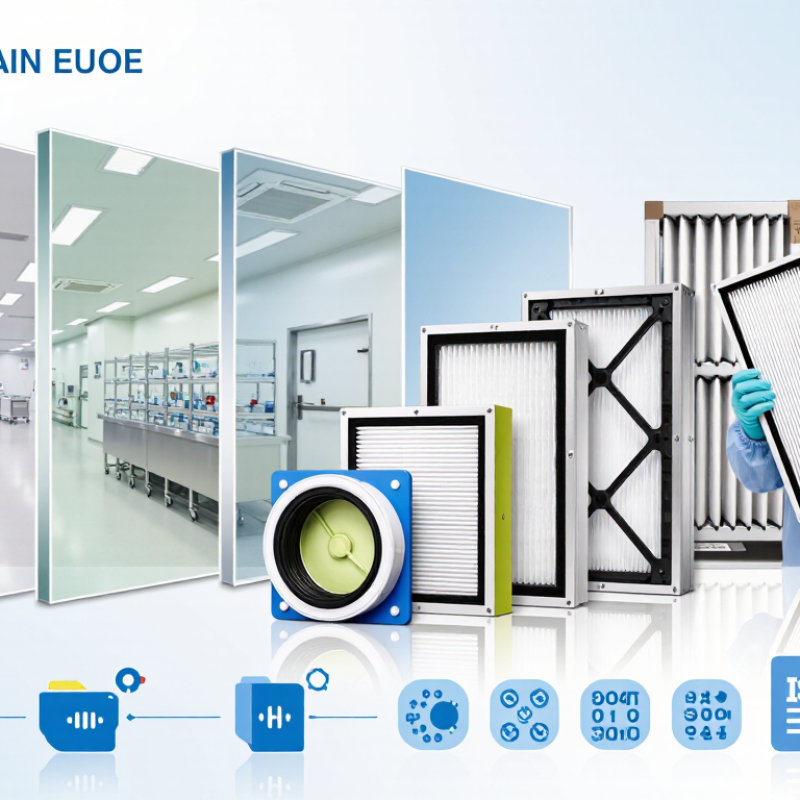
Ceiling filters are not one standard product. Common types include terminal HEPA modules, gel-seal panels, laminar-flow ceilings, and fan filter units. Each serves a different airflow requirement. H13 and H14 filters are widely selected for controlled rooms, while U15 to U17 grades support stricter particle control. Buyers should check filtration efficiency, airflow volume, pressure drop, and rated service life together.

Typical modules use aluminum or galvanized steel frames, with sizes such as 610 × 610 mm or 1,220 × 610 mm. Airflow often ranges from 500 to 1,200 cubic meters per hour, depending on face velocity and filter depth. A low initial pressure drop can reduce energy use, but it may indicate a lighter media design. That is not always better. Gasket, gel, or knife-edge sealing also affects leakage performance. Ask for scan-test results, integrity-test procedures, and reports based on EN 1822 or ISO 29463.

Fan filter units require extra checks. Review motor efficiency, noise levels, speed control, vibration, and accessible replacement panels. For cleanroom projects, confirm ceiling grid compatibility before ordering samples. Small frame differences can create installation problems. I have seen technically strong filters fail because the seal was uneven. Supplier evaluation should include factory quality controls, batch traceability, packaging protection, and inspection records. Test the actual production sample, not only the first approval unit.

Leading Chinese Manufacturers for Global Buyers

China Top Ceiling Filter Manufacturers for Global Buyers?

Leading Chinese Manufacturers for Global Buyers

Chinese ceiling filter manufacturers serve hospitals, laboratories, electronics facilities, and other controlled environments worldwide. Their strengths often include flexible production, competitive pricing, and practical customization. A capable supplier can adjust filter dimensions, frame materials, gasket design, and airflow resistance for different installation systems.

Global buyers should examine more than a polished catalog. Request factory photographs, production records, sample filters, and recent performance test reports. Check filtration efficiency, pressure drop, fire behavior, and media quality. Standards vary by market, so documentation should match the destination country and project requirements. Ask whether testing was completed by an independent laboratory. This detail matters.

Communication quality reveals operational experience. Reliable manufacturers answer technical questions clearly and explain limits without exaggerated claims. They should confirm tolerances, packaging methods, lead times, and replacement procedures in writing. A sample inspection can reveal loose frames, uneven sealant, or damaged media before mass production begins. Small defects become expensive later. The first quotation is rarely the best fit. Some buyers focus too heavily on price and overlook maintenance costs. That is a mistake, though experienced teams still make it. A careful supplier comparison should include factory capability, quality controls, export experience, and after-sales support.

How to Verify Quality, Compliance, and Export Capability

China Top Ceiling Filter Manufacturers for Global Buyers?

How to Verify Quality, Compliance, and Export Capability

Selecting a ceiling filter manufacturer requires more than comparing quotations. Ask for recent factory photographs, production records, and a live video inspection. Check whether the facility controls filter media, frames, gaskets, and final assembly under documented procedures. A clean workshop matters, but process discipline matters more.

Request test reports for airflow, pressure drop, filtration efficiency, and leakage. The report should identify the tested model, media batch, laboratory, and test date. Confirm whether testing follows standards required in your destination market, such as ISO 16890 or EN 1822. Do not accept a generic certificate. It may describe another product. Verify quality records through sample testing before placing a large order.

Export capability appears in small details. The manufacturer should provide accurate packing lists, commercial invoices, product specifications, and shipping marks. Ask how filters are protected from moisture during container transport. Check carton strength and pallet stability with a trial shipment. Also review production lead times, spare-part handling, and responses to complaints. Paperwork can look perfect. It can still hide weak controls. I would not treat one factory visit as proof. A second inspection, independent testing, and clear acceptance criteria provide stronger evidence, even when they increase the initial cost.

China Top Ceiling Filter Manufacturers for Global Buyers

Reference benchmarks for verifying filtration quality, compliance, and export readiness

Quality
EN 1822 classifies HEPA filters by minimum efficiency at the most penetrating particle size (MPPS).
Compliance
Buyers should request valid test reports, traceable product specifications, and applicable quality-management documentation.
Export capability
Verify packaging records, documentation accuracy, shipment experience, and the ability to meet destination-market requirements.

The chart shows published EN 1822 minimum efficiency benchmarks for HEPA classes H13 and H14. It does not represent any company or brand.