Leave Your Message

2026 Best Commercial HEPA Filter Types for Buyers?

Choosing a commercial HEPA filter is not a simple specification exercise. Buyers must match filtration performance with airflow, pressure drop, maintenance access, and operating cost. In 2026, H13 and H14 filters remain common choices, but the highest efficiency rating is not automatically the best purchase. A poorly matched filter can restrict airflow, increase fan energy, and shorten equipment life. Small details matter. Frame depth matters. Seal quality matters. Replacement access matters.

Richard Corsi, a respected indoor air quality researcher, has emphasized, “There is no silver bullet.” That warning deserves attention when comparing every Commercial Hepa Filter type. A V-bank design may provide more media area in limited space. A mini-pleat model may fit compact air-handling equipment. A bag-in/bag-out housing can support safer maintenance in controlled environments. Each option solves a different operational problem. None solves everything.

This guide examines the 2026 best Commercial Hepa Filter types for buyers through a practical, evidence-focused lens. It considers tested efficiency, airflow resistance, particle loading, gasket performance, housing compatibility, and lifecycle value. It also separates manufacturer claims from independently documented results. That distinction is important. A clean laboratory number may not reflect a dusty facility or inconsistent servicing. Buyers should review certification records, test conditions, and replacement procedures before approving a purchase. Even this approach has limits. Real buildings behave unpredictably. Budget forecasts can also be wrong. Still, careful comparison creates a stronger decision than choosing by efficiency percentage alone.

2026 Best Commercial HEPA Filter Types for Buyers?

What Commercial HEPA Filters Are and How They Work

2026 Best Commercial HEPA Filter Types for Buyers?

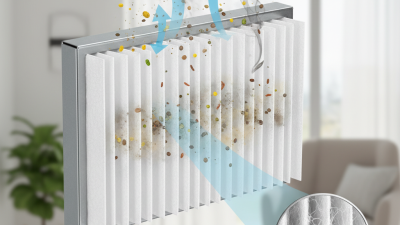
Commercial HEPA filters remove airborne particles through a dense fiber mat. They do not simply act like a kitchen sieve. Larger particles collide with fibers, medium particles stick through interception, and tiny particles move randomly until diffusion captures them. Under common test conditions, many HEPA filters remove at least 99.97% of particles near 0.3 microns. That figure is useful, but it is not a promise for every installation.

Tips: Check the filter class, airflow rating, pressure drop, gasket quality, and test certificate. A deep-pleat or V-bank design often provides more media area than a flat panel. However, the best type depends on the air-handling unit, available space, fan capacity, and maintenance schedule. A filter that performs well in a laboratory may waste energy if the system cannot move air through it. Fit matters greatly.

In field inspections, leakage around the frame can defeat an excellent filter. Dust may bypass the media through a damaged seal or poorly closed access door. Buyers should request performance data from a qualified testing body and compare results under the same standard. Replacement timing should follow pressure readings and site conditions, not a convenient calendar date alone. I would also review noise and energy use, because “highest efficiency” is not always the most practical choice.

2026 Best Commercial HEPA Filter Types for Buyers

What commercial HEPA filters are and how they work: higher EN 1822 classes allow less particle penetration at the most penetrating particle size (MPPS).

H13 and H14 are commonly classified as HEPA grades, while U15 is an ULPA grade used where exceptionally low particle penetration is required. Actual pressure drop, airflow, service life, and housing performance should also be evaluated before purchasing.

Reference basis: EN 1822 minimum integral efficiency at MPPS. Values shown are maximum penetration limits.

Which Commercial HEPA Filter Types Are Available in 2026

Commercial HEPA filter types available in 2026 vary by efficiency class, frame design, and airflow requirements. H13 and H14 filters remain common choices for hospitals, laboratories, clean manufacturing areas, and high-occupancy buildings. Under EN 1822 or ISO 29463 testing, H14 provides higher particle retention than H13, but it usually creates greater resistance.

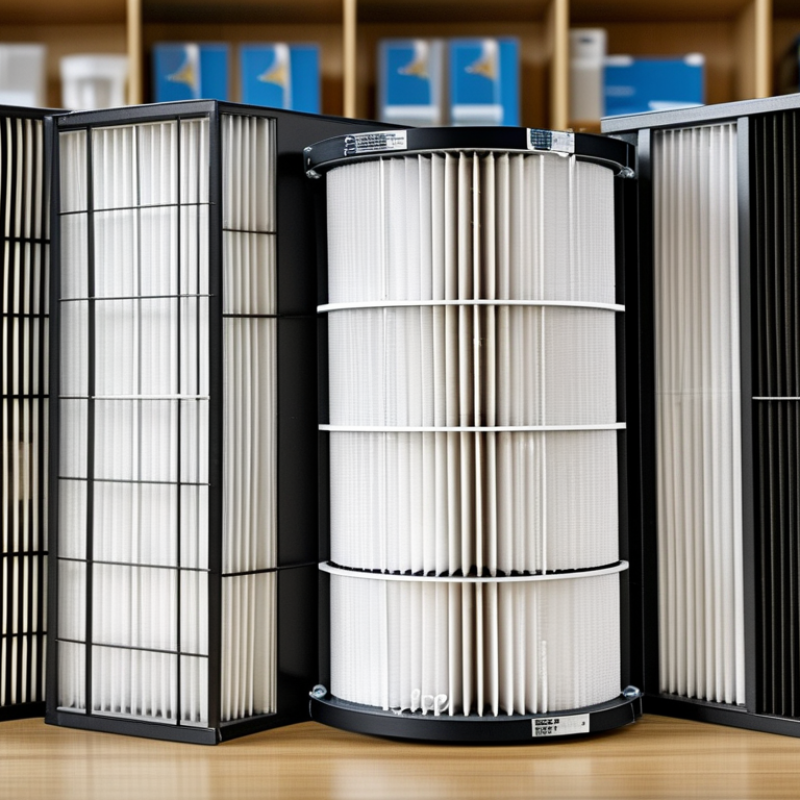
Deep-pleat filters offer large media areas and suit systems needing stable airflow over long operating periods. Mini-pleat designs provide compact depth, which helps when ceiling space is limited. V-bank and multi-bank filters increase the filtration area inside standard air-handling units. Terminal HEPA modules and fan filter units place filtration near the occupied space, such as above cleanroom work zones. Some commercial systems also use metal-separator frames for durability in demanding service rooms.

The filter type must match the equipment, not just the efficiency label. A high-rated filter can reduce airflow when the fan lacks reserve capacity. Check rated airflow, initial pressure drop, final pressure drop, gasket condition, and replacement access before purchasing. In field inspections, poor sealing often causes more concern than the media itself. That detail is easy to miss. Buyers should also confirm test documentation for the exact filter size and configuration. Generic certificates can create uncertainty. I would not choose the deepest model automatically, because a shorter filter with better maintenance access may perform more reliably in daily operation.

How to Compare HEPA Efficiency, Airflow, and Pressure Drop

Commercial HEPA buyers should compare efficiency, airflow, and pressure drop as one system. The U.S. Department of Energy defines conventional HEPA performance as 99.97% removal at 0.3 microns. However, EN 1822 evaluates filters at their most penetrating particle size, or MPPS. H13 requires at least 99.95% efficiency, while H14 requires 99.995%.

Efficiency alone can mislead.

Airflow must be measured at the intended operating point, not only under laboratory conditions. ASHRAE Standard 52.2 testing reports airflow resistance and particle removal under controlled procedures. A filter rated for 2,000 m³/h may deliver less air after loading. Dust accumulation increases resistance, forcing the fan to work harder. The U.S. Department of Energy notes that fan energy can become a major part of air-handling energy use.

Pressure drop is the practical buying test. Compare initial and final resistance, such as 150 Pa initially versus 400 Pa at replacement. Check the filter’s face velocity, dimensions, gasket design, and test airflow. A deeper pleated filter may hold more dust, yet it can restrict poorly designed equipment. Field measurements with a differential-pressure gauge are valuable. Datasheets are not enough. A small mistake in airflow assumptions can erase the expected efficiency gain, especially in older commercial air systems.

Which Industries and Facilities Need Each Filter Type

2026 Best Commercial HEPA Filter Types for Buyers

Different facilities need different HEPA designs, not simply the highest efficiency rating. Hospitals typically specify H13 or H14 terminal filters for operating rooms, isolation rooms, and intensive-care areas. Under EN 1822, H13 provides at least 99.95% efficiency at the most penetrating particle size, while H14 reaches 99.995%. Pharmaceutical cleanrooms often require H14 or ULPA filtration, supported by ISO 14644-1 particle-control requirements. Airflow validation remains essential.

Schools, offices, and retail buildings usually need a practical balance between particle removal, noise, and energy use. ASHRAE Standard 241-2023 introduced equivalent clean airflow, helping facility teams compare filtration with outdoor-air ventilation and portable air cleaning. Portable HEPA units can support classrooms or crowded meeting rooms, especially where central systems cannot deliver adequate airflow. However, oversized equipment may create noise complaints and poor user acceptance.

Manufacturing sites require closer analysis. Electronics facilities may need low-outgassing filters, while food-processing areas often prioritize washable prefilters and moisture control. Industrial spaces with heavy dust should use staged filtration before the HEPA section. The U.S. Environmental Protection Agency reports that filtration performance depends on airflow, filter efficiency, and operating time, not efficiency alone. A neglected prefilter can shorten HEPA service life quickly. That is easy to overlook. Buyers should request tested airflow data, pressure-drop curves, replacement intervals, and documented installation checks. Field conditions are rarely perfect, and a technically superior filter can underperform when maintenance access is poor.

How Buyers Should Select, Install, and Maintain HEPA Filters

Commercial HEPA buyers should match filter type to risk, airflow, and maintenance capacity. H13 and H14 filters are tested under EN 1822 and ISO 29463 at the most penetrating particle size. Their minimum efficiencies are 99.95% and 99.995%, respectively. The U.S. Department of Energy defines HEPA performance as removing at least 99.97% of 0.3-micrometre particles. These figures are not interchangeable. Test conditions matter.

Choose terminal HEPA modules for controlled rooms, deep-pleat units for higher dust loads, and portable systems for flexible occupancy changes. Check clean-air delivery, pressure drop, gasket design, and replacement access. A filter with excellent efficiency can still fail when the fan cannot maintain airflow. ASHRAE Standard 52.2-2017 also warns that MERV ratings and HEPA classifications use different testing methods. Compare like with like.

Install filters with the airflow arrow correctly aligned. Inspect the sealing frame, not only the media. Even a small bypass gap can undermine performance. CDC ventilation guidance supports using properly sized HEPA cleaners to reduce airborne particles, but room placement remains practical work. Keep units away from walls and curtains. Measure differential pressure before and after installation. Replace filters according to pressure readings, airflow loss, or contamination risk, not a convenient calendar date. Records should include dates, readings, and technician observations. No installation is perfect. A rushed inspection may reveal that the filter was efficient, but the room was not.

2026 Best Commercial HEPA Filter Types for Buyers? - How Buyers Should Select, Install, and Maintain HEPA Filters

Performance values are standards-based or typical engineering ranges. Always verify the certified rating, dimensions, airflow, pressure drop, and installation requirements for the specific filter and air-handling unit.
Filter type or buyer factor Typical construction or rating Typical commercial application Advantages Buyer limitations and checks
EN 1822 / ISO 29463 H13 Minimum integral efficiency of 99.95% at the most penetrating particle size (MPPS), when classified under the applicable standard. Commercial buildings, healthcare support areas, laboratories, clean production spaces, and critical HVAC zones. Strong particle removal with generally lower resistance and cost than higher-rated options. Confirm whether the quoted efficiency is integral or overall; check the test standard, airflow, gasket design, and leak-test requirements.
EN 1822 / ISO 29463 H14 Minimum integral efficiency of 99.995% at MPPS, when classified under the applicable standard. Higher-control healthcare areas, pharmaceutical or biotechnology support areas, and applications requiring tighter particle control. Higher certified removal efficiency than H13 under the same classification framework. Usually creates greater initial pressure drop and operating cost; confirm that the fan has sufficient capacity and that the higher grade is justified.
U.S. HEPA efficiency reference Common U.S. specification: at least 99.97% removal of 0.3 micrometre particles under the stated test method. Commercial air cleaners, government or institutional facilities, and HVAC equipment specified using U.S. requirements. Provides a familiar procurement reference for projects using U.S. specifications. Do not directly equate a 0.3 micrometre rating with an MPPS classification without checking the complete test report and standard.
Mini-pleat HEPA filter Fine, closely spaced pleats bonded with separators or hot-melt beads; commonly supplied in compact panels or V-bank modules. Space-constrained air-handling units, terminal modules, cleanrooms, and retrofit projects. High media area in a compact depth; can support lower face velocity across the media. Verify pleat stability, seal integrity, service access, and the manufacturer’s rated airflow and pressure drop.
Deep-pleat or separator HEPA filter Deeper pleat pack, often using corrugated separators to maintain spacing and airflow channels. Large air-handling systems, industrial ventilation, and installations with adequate filter-bank depth. Robust construction and potentially high dust-holding capacity when correctly sized and prefiltered. Requires more cabinet depth and may be heavier; inspect lifting access, support rails, and moisture exposure.
V-bank or multi-V HEPA module Several compact pleated filter packs arranged in a V configuration inside one rigid frame. High-airflow commercial AHUs where a large media area is needed within a limited face area. Large media area and efficient use of cabinet space; often suitable for modular filter banks. Check available depth, airflow distribution, module weight, access clearance, and the replacement procedure.
Terminal HEPA module HEPA filter installed at or near the room boundary, commonly with a diffuser or accessible service housing. Operating rooms, isolation areas, cleanrooms, laboratories, and other controlled spaces. Final filtration close to the occupied or controlled space can reduce downstream contamination risk. The housing, gasket, clamping system, and room-side leak-test access are as important as the filter media rating.
Filter face velocity Airflow divided by the gross filter face area; lower velocity generally reduces pressure drop for the same filter design. All commercial HVAC and air-cleaning installations. Helps buyers compare filter size, airflow capacity, energy demand, and expected service life. Use the certified performance curve rather than selecting by nominal dimensions alone; avoid exceeding the rated airflow.
Initial pressure drop Resistance of a clean filter at a specified airflow; the exact value depends on media, area, frame, and test method. Fan selection, energy modeling, retrofit assessment, and operating-cost comparison. A key value for confirming fan compatibility and estimating energy use. Compare filters at the same airflow and conditions. A low initial value does not necessarily indicate the lowest lifetime cost.
Final or replacement pressure drop The project-defined maximum resistance at which airflow, fan capacity, energy use, or indoor conditions become unacceptable. Maintenance planning and differential-pressure monitoring. Provides an objective replacement trigger instead of relying only on a calendar interval. Set the limit with the equipment designer or facility engineer; do not exceed the fan’s allowable system resistance.
Prefiltration requirement A lower-efficiency upstream filter used to capture coarse dust and extend HEPA service life. Outdoor-air systems, dusty commercial environments, industrial facilities, and high-occupancy buildings. Reduces loading on the HEPA filter and can lower whole-life replacement cost. The prefilter must be compatible with airflow, space, and maintenance access; never use it as a substitute for the required HEPA grade.
Frame, gasket, and seal Rigid frame with a gasket, gel seal, knife-edge seal, or another tested perimeter sealing arrangement. Any installation where bypass leakage could compromise room or process performance. A properly sealed housing prevents unfiltered air from bypassing the media. Match the filter and housing seal type; inspect compression, damage, corrosion, and uneven clamping during every replacement.
Installation orientation Install according to the airflow arrow and the filter or housing instructions; maintain correct upstream and downstream orientation. All HEPA filter banks, terminal modules, and air-cleaning equipment. Preserves intended airflow direction, structural support, and sealing performance. Do not force an incorrectly sized filter into place. Check for gaps, damaged gaskets, loose fasteners, and media contact with adjacent components.
Leak testing and commissioning Visual inspection plus an approved in-place aerosol leak test where required by the project, facility standard, or regulation. Critical environments, controlled rooms, healthcare applications, laboratories, and clean manufacturing. Detects installation leaks, gasket bypass, and damaged media that a visual check may miss. Testing should be performed by qualified personnel using calibrated equipment and documented acceptance criteria.
Routine maintenance Record differential pressure, airflow, alarms, filter condition, room conditions, and replacement dates. All commercial installations, with more frequent monitoring in critical environments. Trend data supports predictable replacement and helps identify abnormal loading or system faults. Do not wash or vacuum standard disposable HEPA media unless the product documentation specifically allows it; replace damaged or excessively loaded filters.
Energy and life-cycle cost Total cost includes purchase, labor, disposal, fan energy, pressure drop, testing, and downtime. Budgeting, retrofit decisions, and long-term facility operation. Encourages comparison of total operating cost rather than purchase price alone. Evaluate filter area, airflow, expected loading, replacement interval, fan control, and energy prices under actual operating conditions.
Buyer selection checklist: Confirm the applicable efficiency standard, required airflow, available installation depth, initial and final pressure drop, seal configuration, prefilter arrangement, maintenance access, leak-testing requirements, disposal method, and total life-cycle cost before placing an order.