For global buyers, selecting the right Laminar Flow Hood Filter is a contamination-control decision, not a simple purchasing task. Filter grade, airflow resistance, sealing quality, and test documentation can affect every exposed sample. A clean white hood may still perform poorly when its filter gasket leaks or its face velocity drifts. Small details matter.
Dr. William C. Hinds, a respected aerosol scientist, offered a practical principle: “A filter is only as good as its installation and maintenance.” This view remains relevant for laboratories, pharmaceutical facilities, hospitals, and electronics manufacturers. The best Laminar Flow Hood Filter should match the hood’s dimensions, fan capacity, airflow pattern, and required cleanliness level. Buyers should examine HEPA or ULPA classification, MPPS efficiency, pressure-drop data, scan-test results, and replacement intervals. ISO 14644 guidance and EN 1822 documentation may support comparison, but certificates alone cannot guarantee field performance.
This 2026 guide examines reliable filter choices for different operating environments and procurement needs. It considers H13, H14, and ULPA options, frame materials, gasket designs, corrosion resistance, packaging, and international delivery concerns. It also highlights supplier transparency, traceability, and after-sales technical support. A lower purchase price can become expensive after repeated replacements, unstable airflow, or failed integrity testing. Sometimes, the specification looks perfect on paper. Real installations are less forgiving. Measurements should decide.
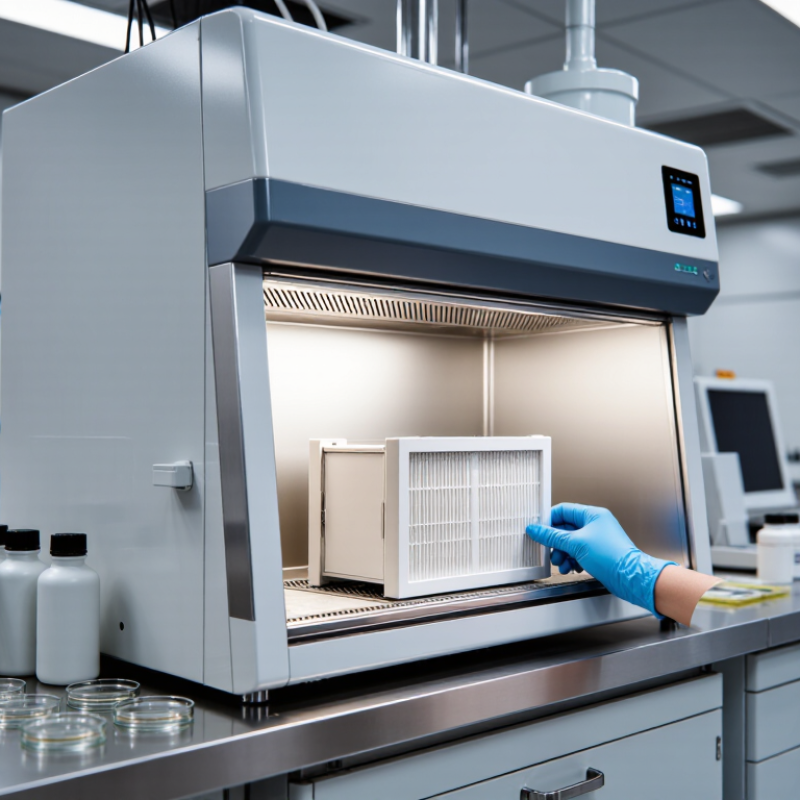
Laminar Flow Hood Filters: Purpose, Structure, and Operating Principles
A laminar flow hood creates a cleaner working zone by moving filtered air in one direction. Its main filter is usually HEPA, while some applications require ULPA performance. These filters capture airborne particles, including dust and many microorganisms attached to particles. They do not remove chemical vapors. They do not disinfect exposed surfaces.
The structure is practical but precise. Room air passes through a prefilter, then reaches the blower and final filter. The final filter contains tightly folded media inside a sealed frame. A diffuser or perforated screen helps distribute airflow evenly. In a horizontal hood, air moves toward the operator. In a vertical hood, air moves downward toward the work surface. The choice affects handling, clearance, and contamination control.
Airflow must remain steady and low-turbulence. Positive pressure helps protect the work zone from surrounding air. Operators should avoid blocking the filter face with containers or tools. Small obstructions can create dead zones. During professional inspections, technicians often use airflow measurements, smoke visualization, and filter integrity testing. A clean-looking filter is not necessarily a reliable filter. That is easy to forget. Buyers should check dimensions, gasket condition, test records, replacement access, voltage compatibility, and local certification requirements. Filter life also depends on room dust, operating hours, and maintenance discipline. No universal “best” filter exists; the correct choice depends on the hood design and the risk being controlled.

This chart compares the maximum rated particle penetration of EN 1822 high-efficiency filter classes at their most penetrating particle size (MPPS). H13, H14, and U15 correspond to minimum integral efficiencies of 99.95%, 99.995%, and 99.9995%, respectively. In a laminar flow hood, the filter creates a uniform, low-turbulence airflow that helps protect the work area from airborne contamination. Final selection should also consider airflow volume, pressure drop, filter dimensions, sealing quality, and required cleanroom classification.
Laminar flow hoods in 2026 rely on filters that protect products from airborne particles. The main choices are HEPA and ULPA filters. HEPA filters commonly remove at least 99.97% of 0.3-micron particles under defined test conditions. ULPA filters offer higher rated efficiency, often above 99.999%, but may create greater pressure loss. That difference affects fan capacity, noise, and energy use. A filter is not automatically better because its rating is higher.
Tips: Check the final test report, filter dimensions, gasket design, airflow direction, and initial pressure drop. Confirm compatibility before ordering.
Global buyers should request scan-test data, efficiency results, and leak-test records from qualified suppliers. The report should identify the test method and rated airflow. For critical work, H13 or H14 HEPA filters may provide a practical balance. U15 to U17 ULPA filters can suit stricter particle-control needs, but the hood must support their resistance. A disposable prefilter can protect the main filter from dust and extend service life. Activated carbon filters are different. They target selected gases, not ordinary particles, and can reduce airflow if added carelessly.
Real installations often reveal small problems. A slightly wrong frame depth can damage the seal. A dirty prefilter can also make a new final filter look defective. Filter replacement should follow pressure readings, airflow checks, and contamination-control records, not calendar dates alone. I would still verify local certification requirements, because global specifications are not perfectly uniform.
| Filter Type / Grade | Rated Particle-Capture Efficiency | Typical Media | Typical Initial Pressure Drop* | Best Application | Main Advantages | Key Buying Considerations |
|---|---|---|---|---|---|---|
| HEPA H13 | At least 99.95% at the most penetrating particle size (MPPS), under EN 1822 classification | Microfine glass-fiber paper; aluminum or galvanized-steel separatorless frame options | Approximately 100–250 Pa, depending on face velocity, media area, and construction | General clean benches, laboratory preparation, and non-hazardous aseptic work | Strong contamination control with comparatively moderate airflow resistance and operating cost | Confirm individually tested performance, gasket integrity, airflow compatibility, and the required replacement dimensions |
| HEPA H14 | At least 99.995% at MPPS, under EN 1822 classification | Microfine glass-fiber media, commonly sealed in a rigid, low-leakage frame | Approximately 120–300 Pa, depending on design and airflow rate | Higher-control pharmaceutical, biotechnology, microbiology, and laboratory workstations | Higher rated efficiency than H13 while remaining widely available for laminar airflow equipment | Ensure the fan can overcome the clean and loaded resistance; request a scan-test certificate when product protection is critical |
| ULPA U15 | At least 99.9995% at MPPS, under EN 1822 classification | High-efficiency microfiber media or specialized membrane media, with robust sealing systems | Approximately 180–400 Pa, subject to media design and face velocity | Ultra-clean processing, sensitive analytical work, and applications requiring very low airborne particle levels | Very high particle removal efficiency and improved control of fine particulate contamination | Check pressure-drop limits, energy consumption, airflow uniformity, and whether the hood is designed for ULPA resistance |
| ULPA U16 / U17 | U16: at least 99.99995%; U17: at least 99.999995% at MPPS, under EN 1822 classification | Specialized ultra-fine fiber or membrane media with carefully controlled construction | Often approximately 250–500 Pa; actual values must be confirmed by the filter manufacturer | Highly controlled clean-air processes where exceptional particle-control performance is justified | The highest efficiency range commonly specified for specialized clean-air systems | Use only when the hood, fan, controls, and validation program support the higher resistance and maintenance cost |
| PTFE Membrane HEPA/ULPA | Available in different HEPA and ULPA grades; efficiency must be verified from the individual test report | Expanded polytetrafluoroethylene membrane laminated to a supporting layer | Frequently lower than comparable glass-media designs, but values vary by area and airflow | Applications needing low particle shedding, chemical resistance, or a compact high-efficiency filter design | Low media weight, strong chemical resistance, and potential energy-saving benefits when correctly selected | Check membrane compatibility, temperature limits, mechanical protection, seal design, and certification method |
| Gel-Seal HEPA/ULPA | Depends on the selected H13, H14, or ULPA filter grade; filter efficiency and leakage are tested separately | Glass-fiber or membrane media installed in a knife-edge frame with a gel seal | Comparable to the underlying media design; the gel system primarily improves perimeter sealing | Validated clean benches and installations where minimizing bypass leakage is a priority | Reliable low-leakage sealing and reduced risk from uneven gasket compression | Verify gel compatibility, installation orientation, knife-edge dimensions, service access, and replacement procedures |
| Disposable Terminal Filter Module | Commonly supplied with H13, H14, or ULPA-rated media; performance depends on the complete tested module | Pleated HEPA or ULPA media in a factory-sealed metal or coated-panel housing | Usually higher than a bare filter because of housing and diffuser components; confirm the complete module curve | Compact hoods and systems designed for quick, controlled filter replacement | Simplified installation, reduced on-site sealing work, and lower risk of handling damage | Confirm module size, connection type, airflow direction, disposal requirements, and access-panel clearance |
Selection Notes for Global Buyers
*Pressure-drop values are indicative design ranges, not universal specifications. Actual performance varies with face velocity, filter depth, pleat configuration, media area, temperature, humidity, and dust loading.
Filter grades should be selected according to the hood manufacturer’s design, required airflow uniformity, applicable local regulations, and the validation protocol. EN 1822 classification is based on MPPS testing; other standards may use different test methods and reporting conventions.
Before ordering, verify nominal and actual dimensions, frame material, gasket or gel-seal arrangement, airflow direction, rated airflow, terminal pressure drop, individual scan-test documentation, and safe replacement requirements.
A reliable laminar flow hood filter needs more than a high efficiency rating. Check its tested performance at the most penetrating particle size. HEPA filters commonly reach 99.97% efficiency at 0.3 microns, while some applications require higher-rated filtration. Request a traceable test report, batch details, and pressure-drop data. A clean-looking filter is not proof of integrity.
Airflow performance deserves equal attention. Measure face velocity across several grid points, not only at the center. Uneven readings may reveal loading, poor sealing, or fan imbalance. Smoke visualization can expose turbulence near the work zone. Differential pressure should be recorded during commissioning and routine checks. Standards such as EN 1822 or ISO 29463 can support comparisons, but local requirements still matter. Field conditions often change results.
Tips: Ask for filter dimensions, gasket type, replacement guidance, and scan-test records. Confirm whether testing covers the complete installed assembly. Keep a baseline for velocity, pressure, and particle counts. Small leaks can matter. One practical lesson is easy to overlook: a technically excellent filter may perform poorly after careless installation. Recheck the seal, airflow pattern, and access door before accepting the hood. Perhaps the most useful review is not the first one, but the follow-up measurement after several weeks of operation.
Global buyers should verify filter standards before comparing price or rated efficiency. HEPA filters commonly follow EN 1822 or ISO 29463 classifications. H13 and H14 grades are widely specified, but the grade alone does not prove suitability. Ask for the latest individual test report, leak-test method, airflow data, and traceable serial information. A certification logo is not enough.
Compatibility requires equal attention. Measure the filter frame, gasket position, depth, and clamping space. Confirm the hood’s airflow direction and pressure-drop limits. A replacement filter may fit the opening but overload the fan. That mistake can reduce velocity and disturb the clean working zone. Check voltage, frequency, connector type, and local electrical requirements. CE or UKCA marking may apply in some markets, while other regions may require separate electrical approvals or documentation.
ISO 14644-1 can help assess airborne cleanliness, although it does not certify a filter by itself. Import documents should match the product, manufacturer, destination, and declared performance. Request installation guidance and acceptance-test procedures before shipment. I would not treat a familiar filter grade as sufficient evidence. Field conditions, transport damage, and imperfect seals can change results. A careful buyer should allow room for that uncertainty.
Choosing a laminar flow hood filter is not simply a matter of selecting the smallest particle rating. The application decides the needed balance between cleanliness, airflow, pressure drop, and service life. For routine sterile handling, a certified HEPA filter may provide suitable protection. More demanding procedures may require an ULPA option, but higher efficiency can increase resistance and energy use. Check the hood’s airflow design before upgrading.
Measure the operating conditions carefully. Review face velocity, filter dimensions, gasket style, frame material, and allowable pressure drop. A filter that fits the opening may still leak around the seal. It may also disturb the uniform airflow pattern. Ask for independent efficiency data, factory test results, and traceable serial records. Local standards and import requirements should also be confirmed before shipment.
Prefilters can reduce dust loading and extend the final filter’s service life. However, they need scheduled inspection and replacement. Do not judge performance by appearance alone. A clean-looking filter can have hidden damage or excessive resistance. I have seen purchasing teams choose a cheaper unit, then discover that its replacement interval was too short. That decision looked efficient on paper. It was not. Compare total operating cost, testing access, packaging quality, and technical support across climates and transport routes. Installation should include leak testing and airflow verification by qualified personnel. Even experienced teams can miss a loose corner.