Leave Your Message

Top 10 HEPA Filter Manufacturers for Global Buyers

Global buyers need more than a long supplier list. They need evidence, consistency, and clear technical fit. This guide introduces the Top 10 HEPA Filter Manufacturers for Global Buyers, focusing on proven production capabilities, filtration performance, certifications, and international service.

A reliable Hepa Filter manufacturer should explain efficiency ratings, pressure drop, airflow capacity, sealing methods, and test procedures. It should also provide traceable reports, stable batch quality, and practical replacement support. A cleanroom may depend on a filter operating continuously, while a hospital requires dependable contamination control and documented validation. Details matter.

Dr. Richard Corsi, a respected indoor-air-quality expert, has said, “Clean air is a human right.” That principle gives this comparison a wider purpose. Buyers are not choosing a simple frame and media assembly. They are protecting workers, patients, products, and public spaces.

This ranking considers manufacturing experience, laboratory capability, product range, customization, export reliability, and technical communication. It also examines whether suppliers explain limitations honestly. No list is flawless. Market data changes, and performance can vary between models, installations, and operating conditions. That is worth remembering.

Look beyond impressive claims. Ask for current test documentation. Check gasket compression, dimensions, media construction, and delivery records. A manufacturer that answers clearly is often easier to trust when problems appear. Through these practical criteria, global buyers can compare leading Hepa Filter manufacturers with greater confidence and fewer costly assumptions.
Top 10 HEPA Filter Manufacturers for Global Buyers

What Defines a HEPA Filter Manufacturer for Global Buyers

A HEPA filter manufacturer for global buyers must offer more than a clean product photograph. It needs proven manufacturing experience, controlled processes, and repeatable testing. Buyers should examine whether the factory measures filtration efficiency, pressure drop, airflow, and leakage for every production batch. Clear test reports matter.

Technical authority comes from qualified engineers and recognized standards, such as EN 1822 or ISO 29463. A dependable manufacturer can explain testing equipment, aerosol methods, gasket materials, and frame construction without vague claims. It should also provide serial numbers, inspection records, and traceable raw-material data. Small details matter. A missing document can delay installation or weaken confidence during an audit.

Global supply also requires practical reliability. Strong packaging should protect pleats and seals during long-distance transport. The supplier should understand voltage-free equipment, regional labeling, customs documents, and replacement schedules. Samples help, but they can mislead if production quality changes later. No manufacturer is flawless. Even experienced factories may face material shortages or unexpected pressure-drop variation. Honest communication, corrective-action records, and realistic lead times reveal more than polished sales language. A serious buyer should visit the facility when possible, inspect the test area, and compare delivered performance with the original specification.

Key Technologies Used in Modern HEPA Filter Production

Modern HEPA filter production begins with fine-fiber media, often formed through meltblown processes. These fibers create narrow passages that capture particles by interception, diffusion, and inertial impact. Electrostatic treatment can improve particle capture without making the media excessively dense. This balance matters because higher efficiency often increases airflow resistance.

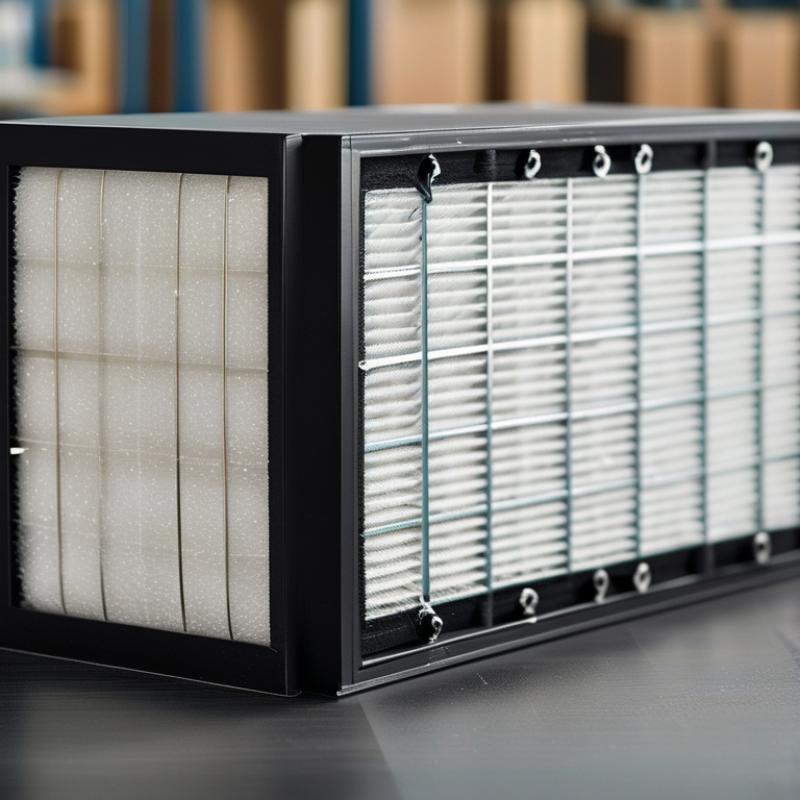
Advanced manufacturers control fiber diameter, basis weight, and charge stability during production. Automated pleating machines fold the media into uniform channels, increasing surface area inside a compact housing. Spacers help prevent pleat collapse under continuous airflow. Small errors can still create uneven gaps. That weakness deserves attention.

Reliable production also depends on sealing and testing. Adhesive beads must remain continuous around the frame, especially at corners. A perfect filter media is ineffective if air bypasses the seal. Manufacturers commonly use automated leak scanning and particle-counting systems under controlled airflow. Testing methods aligned with ISO 29463 or EN 1822 can support comparable performance claims. However, results depend on airflow rate, test aerosol, and instrument calibration. Buyers should review pressure-drop data, leak-test records, and batch traceability, not only the headline efficiency rating. Field inspections may reveal installation problems that factory testing cannot predict.

How to Evaluate the Top HEPA Filter Manufacturers

How to Evaluate the Top HEPA Filter Manufacturers

A reliable manufacturer should prove performance, not simply print “HEPA” on a carton. The U.S. Department of Energy defines a conventional HEPA filter as removing at least 99.97% of 0.3-micron particles under specified conditions. However, ISO 29463 evaluates filters near their most penetrating particle size, or MPPS. Ask for complete test reports, laboratory details, airflow rates, and pressure-drop results. A single efficiency percentage is incomplete.

Check whether testing follows ISO 29463 or EN 1822, while air-cleaner systems may use ASHRAE Standard 52.2 methods. ASHRAE’s framework measures particle removal across defined size ranges, helping buyers compare performance more realistically. The U.S. EPA also stresses that clean-air delivery depends on both filtration efficiency and airflow. A dense filter can perform well in a laboratory but restrict a fan in practice. Look for independent certification, batch traceability, gasket inspection, and stable performance after vibration and humidity exposure. Ask for replacement schedules too.

Cost deserves careful attention. A lower purchase price may hide higher energy use or frequent replacement. Request lifecycle calculations using the buyer’s operating hours and electricity rates. I would not trust polished charts without raw data. A spreadsheet alone is not enough. Some manufacturers provide excellent documents but weak field support; others do the reverse. Visit the production site when possible, inspect pleat uniformity, and compare samples from different batches. Small gaps matter.

Top 10 HEPA Filter Manufacturers for Global Buyers - How to Evaluate the Top HEPA Filter Manufacturers

Rank Evaluation Dimension Buyer-Verified Data Relevant Standard or Test Method Why It Matters
1 Filter Classification Confirm whether the product is classified as H13 or H14. Under EN 1822 and ISO 29463, H13 requires a minimum overall efficiency of 99.95% and H14 requires 99.995% at the most penetrating particle size. EN 1822; ISO 29463 Provides a consistent basis for comparing particle-removal performance.
2 Factory Leak Testing Request an individual filter scan-test report or certificate showing the test aerosol, test airflow, penetration result, and acceptance limit. EN 1822-4 and EN 1822-5; ISO 29463-4 and ISO 29463-5 Detects leaks in the media, seals, frames, and separators that nominal efficiency data may not reveal.
3 Airflow and Pressure Drop Compare rated airflow, initial pressure drop, recommended final pressure drop, and the exact test conditions. Do not compare pressure-drop values without matching airflow and filter size. EN 1822; ISO 29463; manufacturer performance curves Lower pressure drop can reduce fan energy consumption, but it must be evaluated together with filtration efficiency.
4 Media and Separator Construction Verify the media type, pleat spacing, separator design, adhesive system, and media-support method. Separatorless mini-pleat construction should be clearly identified when applicable. Technical datasheet; material declarations; production specification Construction affects airflow distribution, mechanical stability, vibration resistance, and service life.
5 Frame, Gasket, and Seal Compatibility Check frame material, gasket material, gasket position, gel-seal or dry-seal configuration, mounting depth, and allowable dimensional tolerances. Project specification; installation standard; dimensional inspection records A high-efficiency filter cannot perform correctly if the housing interface allows bypass leakage.
6 Cleanroom and HVAC Application Experience Ask for application references covering pharmaceutical, healthcare, semiconductor, laboratory, food-processing, or commercial HVAC installations, as relevant to the project. ISO 14644 series; project-specific validation protocol Relevant application experience helps reduce installation, validation, and replacement risks.
7 Quality Management and Production Control Verify a current quality-management certificate, documented incoming-material inspection, controlled assembly procedures, calibration records, and nonconformance handling. ISO 9001; internal quality-control procedures Documented process control improves consistency across production batches.
8 Traceability and Documentation Require batch or serial identification, individual test records where applicable, inspection reports, packing-list traceability, installation guidance, and replacement recommendations. Quality plan; certificate of conformity; inspection and test plan Traceability supports audits, warranty claims, root-cause analysis, and regulated operations.
9 Customization and Supply Capability Evaluate available dimensions, custom frame options, gasket configurations, airflow directions, packaging requirements, minimum order quantities, production lead time, and export documentation. Approved drawing; commercial quotation; delivery schedule A technically suitable filter is only useful if it fits the equipment and can be supplied on schedule.
10 Lifecycle Cost and After-Sales Support Compare purchase price, expected service interval, pressure-drop trend, energy impact, replacement availability, warranty terms, technical support, and disposal requirements. Total-cost-of-ownership analysis; warranty and service documentation The lowest initial price may not represent the lowest operating cost over the filter’s service life.

Buyer note: Classification, airflow, pressure drop, leakage, dimensions, and service-life data should be verified against the exact model, size, and test conditions supplied for the project.

Regional Strengths and Market Coverage of Leading Suppliers

Top 10 HEPA Filter Manufacturers for Global Buyers

Regional strengths matter as much as filter efficiency. MarketsandMarkets estimates the global HEPA filters market could grow from about USD 3.5 billion in 2023 to USD 5.2 billion by 2028. Demand is strongest where hospitals, laboratories, electronics plants, and commercial buildings require controlled air quality. North American suppliers often lead in certification support, retrofit planning, and long-term maintenance. European producers typically emphasize energy efficiency and lifecycle performance, reflecting stricter building standards.

East Asia remains a major production center, supported by dense electronics and semiconductor supply chains. Its strength is scale, short lead times, and specialized cleanroom formats. Southeast Asian suppliers benefit from expanding healthcare and manufacturing investment, but humidity can complicate media storage and installation. In the Gulf region, manufacturers focus on coarse pre-filtration because dust loads can quickly reduce HEPA service life. Practical experience matters here.

The IQAir 2024 World Air Quality Report found that only around 17% of monitored countries and territories met the World Health Organization’s annual PM2.5 guideline. That figure supports continued demand, but it does not prove every HEPA solution will perform equally. Buyers should compare EN 1822 or ISO 29463 testing, pressure drop, gasket design, and replacement access. Some market reports combine residential, industrial, and HVAC products, which weakens direct comparisons. A regional supplier may therefore outperform a larger exporter when installation knowledge and after-sales response are decisive.

Certification, Quality Control, and Export Considerations

Global buyers evaluating top ten HEPA filter manufacturers should inspect evidence, not polished catalogs. A valid quality system certificate supports consistency, but it does not prove every filter meets its efficiency claim. Ask for current ISO 29463 or EN 1822 test reports, including tested airflow, pressure drop, and filter grade. Reports should identify the laboratory, sample number, date, and test method. Be careful with old certificates. They may describe another factory or product line.

Reliable production control appears on the shop floor. Incoming media should be checked for basis weight, fiber damage, and moisture. During assembly, operators need documented adhesive ratios, curing conditions, separator spacing, and frame dimensions. Finished units should receive individual leak testing, efficiency verification, and traceable serial labels. Request calibration records for aerosol generators, photometers, and pressure gauges. A clean room looks impressive, yet uncontrolled sampling can hide weak corners. Paperwork can mislead.

Export readiness involves more than placing filters in a wooden crate. Confirm carton strength, moisture barriers, shock protection, and storage limits before shipment. The supplier should provide a packing list, commercial invoice, certificate of origin when required, and accurate product specifications. Check whether local import rules require language labels, energy data, or safety declarations. Ask how rejected units are quarantined and replaced. My review process is not perfect; packaging may fail during humid transit. A pilot shipment, inspection photos, and arrival measurements can expose problems before a full container is booked.