Choosing the right Hepa Air Filter sounds simple until product labels begin competing for attention. A glossy box may promise cleaner air, yet performance depends on more than the word “HEPA.” Room size, airflow, filter fit, noise, and replacement costs all matter. In a small bedroom, a poorly matched purifier can run loudly while leaving dust near the window untouched. That detail is easy to miss.
This guide presents 10 practical tips for comparing air filters with greater confidence. It considers verified specifications, independent testing, energy use, and manufacturer guidance. Look for a genuine HEPA classification, suitable clean air delivery rate, and a sealed design that limits air leakage. Check the replacement schedule, too. A filter ignored for months may collect dust and restrict airflow. Not ideal.
Personal experience also teaches an uncomfortable lesson: the most expensive model is not always the most effective choice. I once focused too heavily on advertised filtration percentages and overlooked operating noise. That mistake made consistent use less likely. Reliable decisions require evidence, realistic room measurements, and honest expectations. No residential filter removes every pollutant. Some problems require ventilation, source control, or professional assessment. These tips aim to make your selection clearer, while acknowledging that household air quality can change from one room, season, and lifestyle to another.
A HEPA filter is a dense mat of synthetic or glass fibers. It does not simply act like a kitchen sieve. Air moves through winding passages, where particles collide with fibers, stick through interception, or slow down through diffusion. The most difficult particles to capture are near 0.3 microns. Under controlled test conditions, a true HEPA filter can remove at least 99.97% of these particles. This figure describes performance, not every room.
That distinction matters when choosing an air filter. HEPA media can capture dust, pollen, many mold spores, and some airborne particles attached to droplets. It does not remove most gases or odors unless another material handles them. Check the filter’s dimensions and seal. A small gap around the frame can let dirty air bypass the filter. More airflow is not always better. A powerful fan may create noise, while a restrictive filter can reduce circulation.
Look at clean-air delivery information, replacement costs, and the manufacturer’s test details. In a bedroom, I would check whether the unit moves air quietly at night. I would also inspect the filter after several weeks, especially near dusty windows or pets. A gray surface is not a complete safety report. I once assumed a thicker filter was automatically superior; that was too simple. Thickness, fiber design, airflow, and proper maintenance work together. Follow the replacement guidance, but adjust it when the filter becomes visibly loaded or airflow weakens.
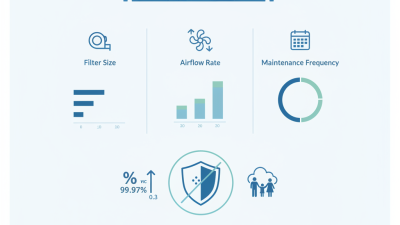
10 Tips for Choosing the Best HEPA Air Filter
Matching filter efficiency to indoor air quality needs requires more than choosing the highest rating. A true HEPA filter can capture at least 99.97% of particles around 0.3 microns under controlled testing. However, room size, airflow, and filter fit matter just as much. A dense filter may reduce airflow in an older purifier or heating system. That can weaken real-world performance. Check the equipment manual before upgrading.
Tip 1: Identify your main concern. Seasonal pollen, pet dander, wildfire smoke, and fine dust require different priorities. For smoke, select a purifier with strong clean air delivery and adequate room coverage. For allergies, consistent particle removal matters more than extreme airflow. Keep doors and windows closed during outdoor pollution events. Small details matter.
Tip 2: Measure the room, then compare its size with the purifier’s tested coverage. Independent test data is more useful than vague “premium” claims. Replace filters when they look gray, airflow drops, or the manufacturer’s schedule requires it. I have found that waiting for visible dirt can be misleading. Some filters remain fairly clean while airflow slowly declines. Tip 3: Consider noise and energy use, because a slightly less powerful unit running continuously may outperform a stronger unit switched off. This is not perfect science. Your household habits still shape the result.
| No. | Selection Tip | What to Check | Useful Benchmark | Best Match for Indoor Needs | Practical Action |
|---|---|---|---|---|---|
| 1 | Confirm the HEPA classification | Look for a clearly stated particle-removal efficiency and test basis. | A commonly recognized true HEPA specification is at least 99.97% efficiency at 0.3 micrometers under the applicable test method. | Homes needing strong reduction of fine particles such as dust, pollen, and some airborne particulate matter. | Choose a product with independently documented performance rather than relying only on the word “HEPA.” |
| 2 | Match airflow to room size | Compare the unit’s clean air delivery rate with the room’s floor area and ceiling height. | For a quick estimate, required CADR can be approximated as: CADR ≈ room volume × target air changes per hour ÷ 60. |
Larger rooms, open-plan areas, or spaces with elevated particle levels need higher airflow or multiple units. | Use the manufacturer’s stated CADR and select a unit rated for the actual room, not just the smallest listed area. |
| 3 | Prioritize CADR over efficiency alone | Evaluate both filter efficiency and the amount of filtered air delivered. | A very efficient filter with insufficient airflow may clean a room more slowly than a properly sized unit with comparable efficiency. | Users who need faster reduction of smoke, fine dust, or seasonal outdoor particles. | Compare clean air delivery rate at a comfortable operating speed, not only at the loudest setting. |
| 4 | Account for particle sources | Identify whether the main concern is dust, pollen, smoke, cooking particles, or general airborne particulate matter. | HEPA filtration targets particles; it does not remove most gases, odors, or carbon dioxide by itself. | Particle concerns are best addressed with HEPA filtration plus source control and ventilation where appropriate. | Reduce emissions at the source, use kitchen exhaust when cooking, and avoid depending on filtration alone. |
| 5 | Check for an activated carbon stage | Determine whether odor or gaseous pollutants are part of the indoor air problem. | Activated carbon can help adsorb some odors and gases, but effectiveness depends on carbon quantity, contact time, and the specific pollutant. | Kitchens, pet areas, rooms affected by mild odors, and spaces where some volatile compounds are a concern. | Select a unit with a substantial carbon bed when odor control matters; thin carbon sheets have limited capacity. |
| 6 | Consider pressure drop and noise | Review the sound level and whether the fan can maintain airflow as the filter loads. | Higher-resistance filters may require more fan power. Noise ratings are commonly reported in decibels and vary by speed. | Bedrooms, nurseries, offices, and other spaces where continuous operation is important. | Choose a quiet setting that still provides adequate airflow, and avoid blocking the intake or outlet. |
| 7 | Plan for filter replacement | Check filter availability, replacement cost, installation method, and maintenance indicators. | Replacement intervals vary with operating hours, indoor particle levels, pets, smoke, and filter loading; a calendar estimate is not universal. | Busy households, homes with pets, and locations affected by seasonal smoke or dust. | Inspect the filter regularly and replace it when visibly loaded, airflow declines, or the service indicator signals replacement. |
| 8 | Use a prefilter when appropriate | Look for a washable or replaceable prefilter that captures larger particles before they reach the HEPA media. | A prefilter can reduce hair and larger dust loading on the main filter, but it must be cleaned or replaced as directed. | Homes with pets, visible dust, fibers, or frequent larger-particle contamination. | Keep the prefilter clean while ensuring it is completely dry before reinstalling it. |
| 9 | Verify fit and air sealing | Make sure the replacement filter matches the correct dimensions and seals properly inside the housing. | Air bypass around the filter can reduce real-world performance, even when the filter media has high laboratory efficiency. | Central HVAC systems, portable air cleaners, and any setup where the filter edge must form a tight seal. | Measure the existing filter, follow the airflow-direction arrow, and check the gasket or frame for gaps. |
| 10 | Combine filtration with source control | Assess ventilation, moisture, cleaning practices, combustion sources, and pollutant entry from outdoors. | Air cleaners supplement—not replace—source control, appropriate ventilation, and moisture management. | Any indoor environment requiring a broader air-quality strategy rather than particle filtration alone. | Control pollution at its source, maintain suitable ventilation, and use HEPA filtration as one part of the overall plan. |
10 Tips for Choosing the Best HEPA Air Filter?
How to Select the Correct Filter Size and Compatibility
A HEPA filter works only when it fits the equipment and seals properly. Measure the existing filter’s length, width, and thickness with a tape measure. Do not rely only on printed numbers. Some listed sizes are nominal, while the actual filter is slightly smaller. Write down both measurements.
Check the appliance manual before buying a replacement. Portable purifiers, HVAC systems, and air handlers use different filter designs. Confirm the filter’s shape, frame material, airflow direction, and mounting method. The arrow should point toward the fan or clean-air outlet. It matters. A loose frame can allow unfiltered air to bypass the media.
Review the equipment’s airflow requirements as well. A dense HEPA filter may increase resistance, especially in older systems. Watch for weak airflow, unusual noise, or overheating after installation. These signs deserve attention, not guesswork. Look for clear performance information, testing references, and replacement guidance from reliable technical sources. Avoid vague claims such as “medical grade” without supporting details. A gasket may improve sealing, but it cannot fix the wrong dimensions. In practice, measuring twice feels excessive. It is cheaper than forcing an unsuitable filter into place.
10 Tips for Choosing the Best HEPA Air Filter?
Airflow determines how quickly a filter can refresh your room. Look for clean air delivery rate, not only the fan’s maximum airflow. A high airflow number may ignore pressure from the filter. Check performance at several fan speeds. Room size labels can also be optimistic. Measure your room and compare its volume with the stated delivery rate. In a small bedroom, steady medium airflow often feels more useful than short bursts at maximum power. Filter resistance usually increases as dust collects, so performance can change over time.
Noise matters because a filter must run for many hours. Review decibel readings at the distance you will actually sit or sleep. Ask whether the test used low, medium, or turbo mode. Quiet on paper may still sound intrusive beside a bed. I once underestimated a soft motor hum. It became annoying after several nights. Personal comfort is not a laboratory result, but it affects real use.
Check power consumption in watts for every speed. Then compare energy use with clean air delivery, rather than choosing the lowest wattage alone. A weak fan may save electricity while cleaning slowly. Calculate estimated yearly cost using your local electricity rate and expected running time. Automatic sensors can reduce energy use, but their readings may respond poorly to cooking fumes or open windows. Independent test data is valuable when available. Also inspect replacement-filter costs and service intervals. A heavily loaded filter can increase noise, reduce airflow, and raise energy demand.
A HEPA filter’s lifespan depends on particle load, fan speed, room dust, and operating hours. In a clean bedroom, it may last six to twelve months. A workshop, pet area, or smoky room can shorten that period sharply. Check the filter monthly with a flashlight. Gray pleats are a warning, not a precise replacement date.
Maintenance should protect the filter rather than damage it. Clean the prefilter when its surface looks dusty, if the unit includes one. Never wash the HEPA media unless the manufacturer explicitly permits it. Moisture can encourage microbial growth and weaken the filter structure.
Listen for louder fan noise and watch for reduced airflow. These signs often appear before the filter looks completely blocked.
Replacement cost includes more than the filter’s purchase price. Record the filter price, shipping, labor, and the electricity used by a struggling fan. A cheaper filter may require frequent changes, while an expensive filter may last longer under the same conditions. Compare cost per month, not just cost per item. My own estimates are imperfect because indoor dust levels change constantly. A pressure reading or airflow measurement gives better evidence than guesswork. Keep receipts and replacement dates. Small records prevent expensive surprises.